Pasts Imperfect (2.5.26)

This week, medievalist and historian of race Cord J. Whitaker discusses the National Park Service's removal of an exhibit on American slavery at Philadelphia’s Independence National Historical Park. Then, a new digital humanities project examines the ancient and modern artifacts of refugees, an open access Latin reader on women in myth, the history and reception of Numidia and Rome, the forgotten Chinese cowboys of Eastern Oregon, myths of the ancient taiga, new ancient world journals, and much more.
Our President's Silenced Slaves—and the Case to Make Their Voices Heard by Cord J. Whitaker
*January 30, 2026. A courtroom in the James A. Byrne U.S. Courthouse.*
Everyone in the courtroom spoke in hushed tones while they awaited Judge Rufe to begin proceedings—save for a few excited law clerks who spoke near full volume.
Anticipation was palpable, even as the subject was depressing for many in the room.
The judge finally entered. All rose from their seats. At this point I noticed, not that it mattered entirely, that the judge, her deputies, and all the city’s lawyers, were women, of varied races. They all had a sense of style.
The federal government’s lawyers were two men. Both white. Somewhere in their thirties. In nondescript dress. Black suits, rather ill fitting. Even their socks were devoid of interest.
The two parties—the judge called it a “clash of Titans”—came to debate the merits of the city’s lawsuit against the National Park Service and the Department of the Interior.
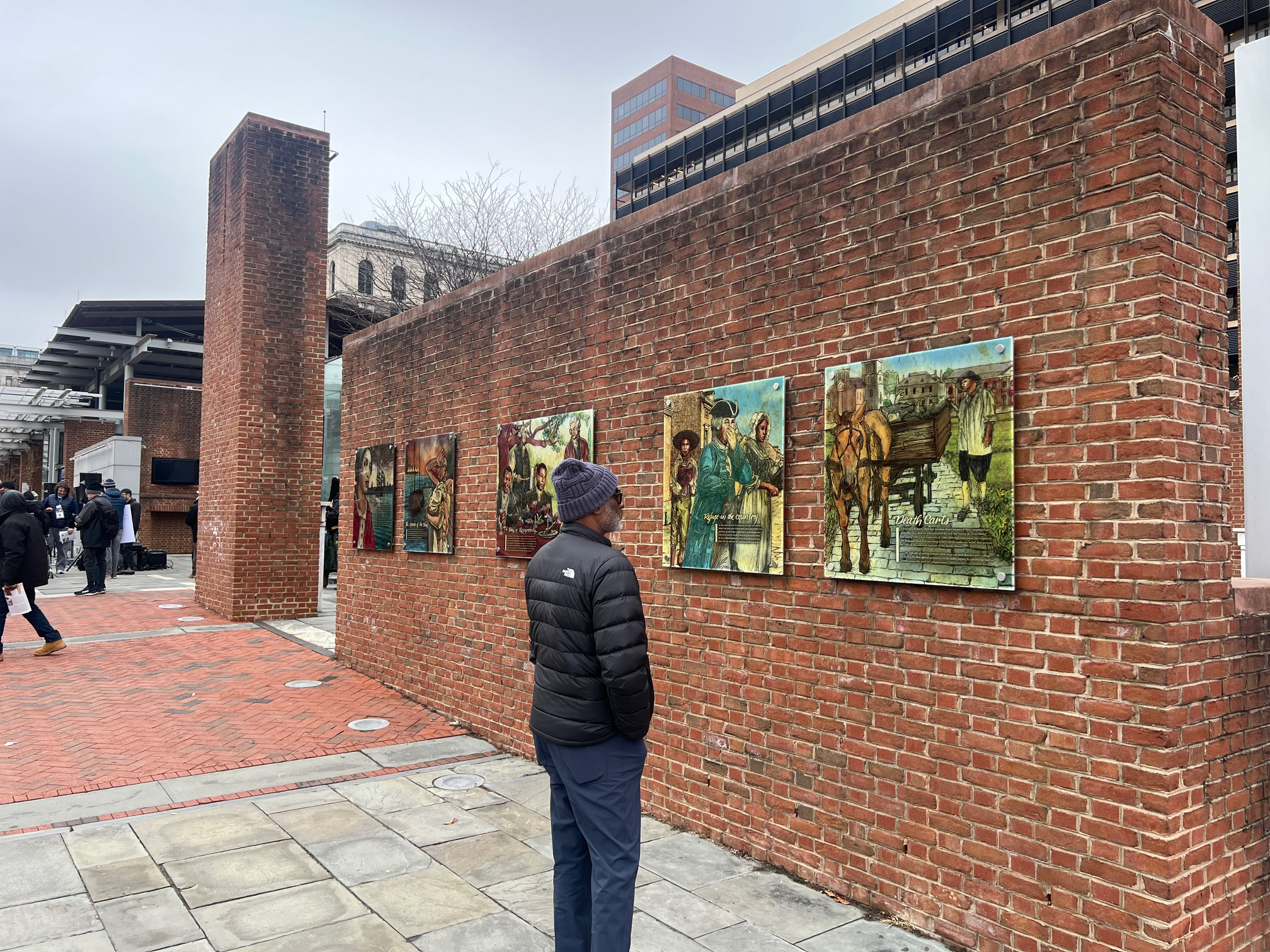
On Thursday, January 22, 2026, Philadelphians had been shocked to find federal workers tearing educational panels from the walls that demarcate the footprint of the U.S.’s first executive mansion. The President’s House also serves as the entry to the Liberty Bell pavilion.
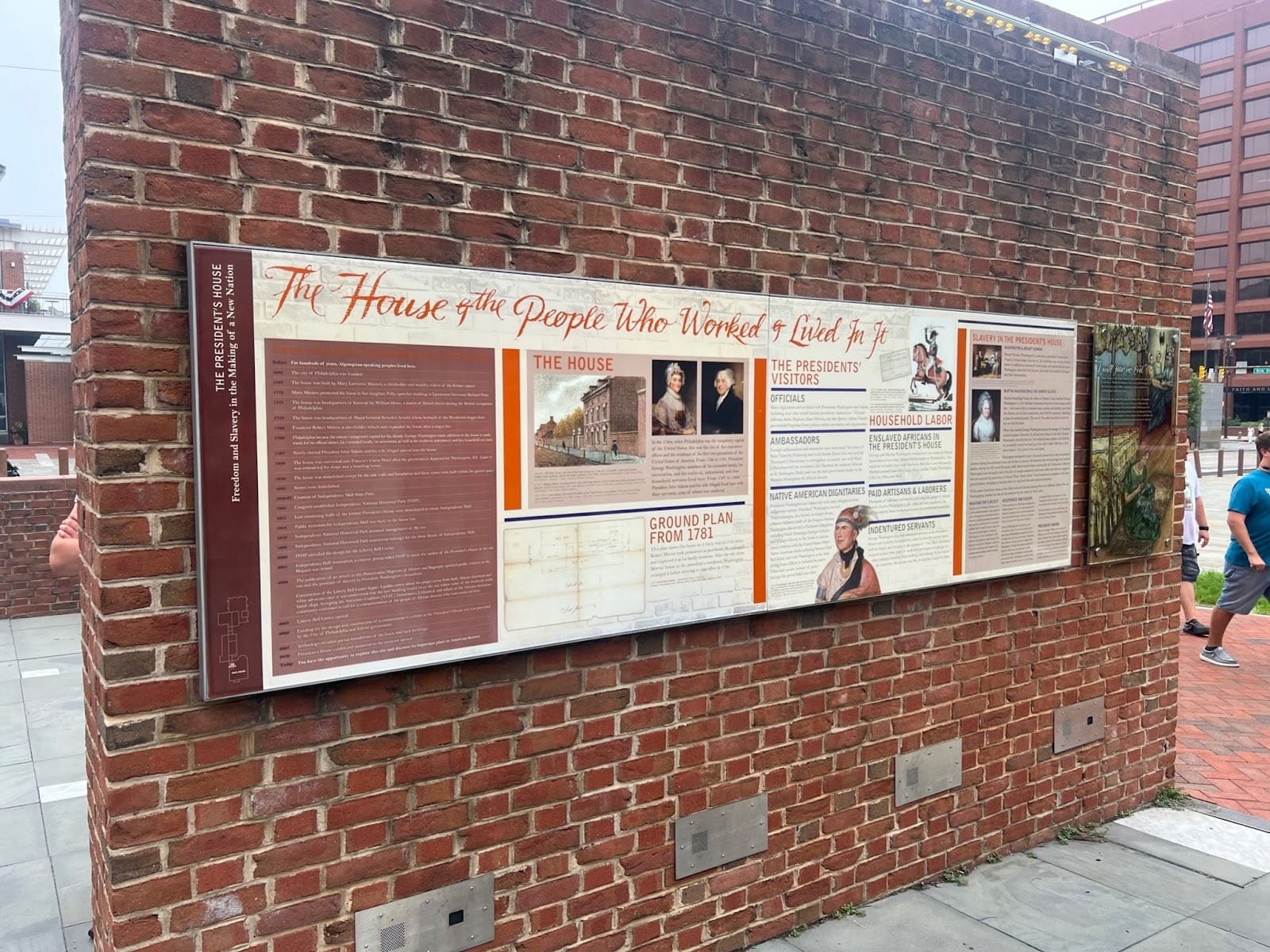
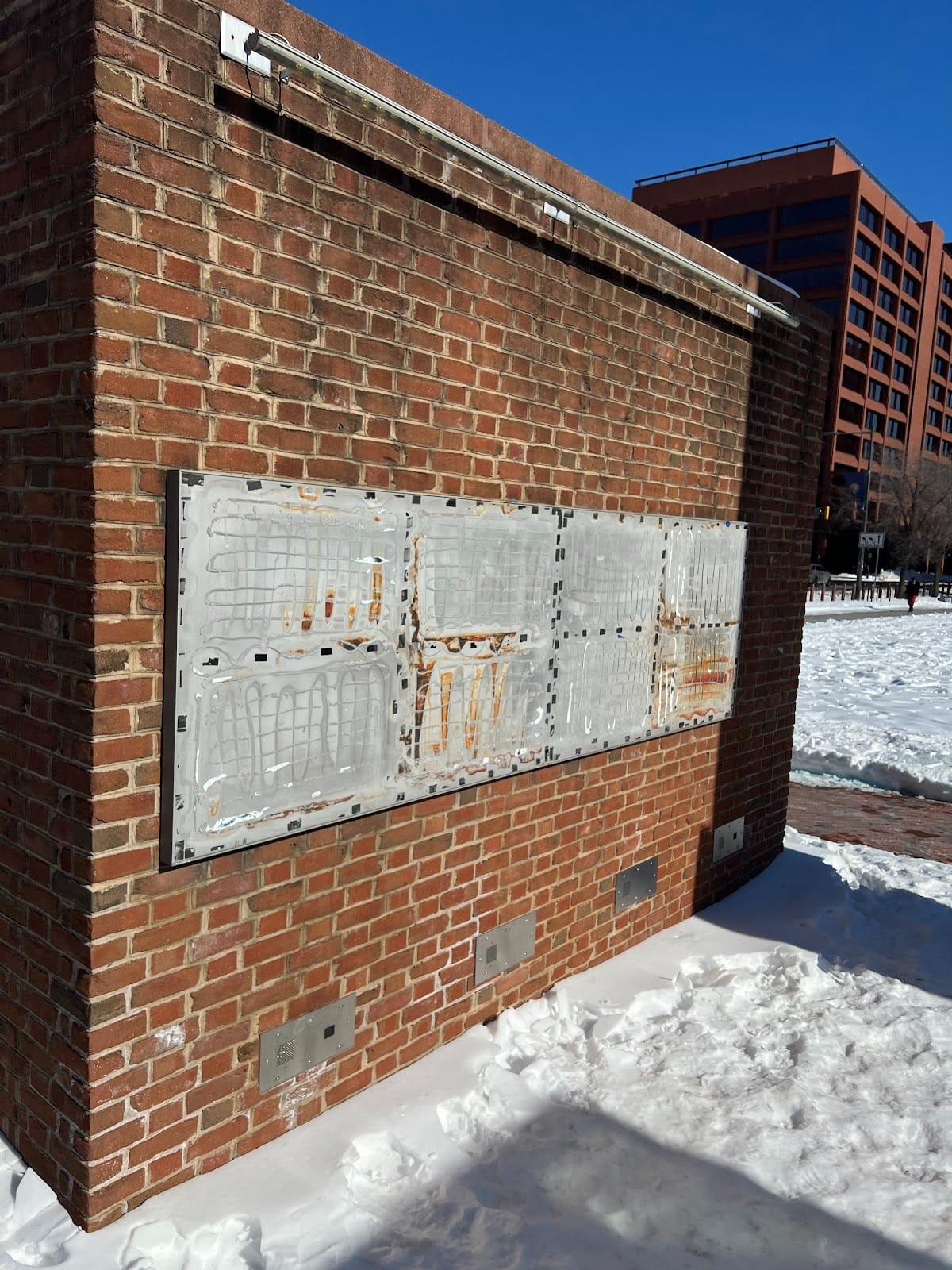
Since 2010, and after at least a decade of negotiation and planning before that, an exhibit commemorating the lives of the nine African-descended people whom George Washington held as slaves in the President’s House has greeted visitors to the Bell, Independence Hall, and the National Constitution Center across the street. It came together as a joint effort of local scholars including especially historian of the Independence Hall Association Ed Lawler, the Avenging the Ancestors Coalition headed by attorney Michael Coard, the city of Philadelphia, and the National Park Service.
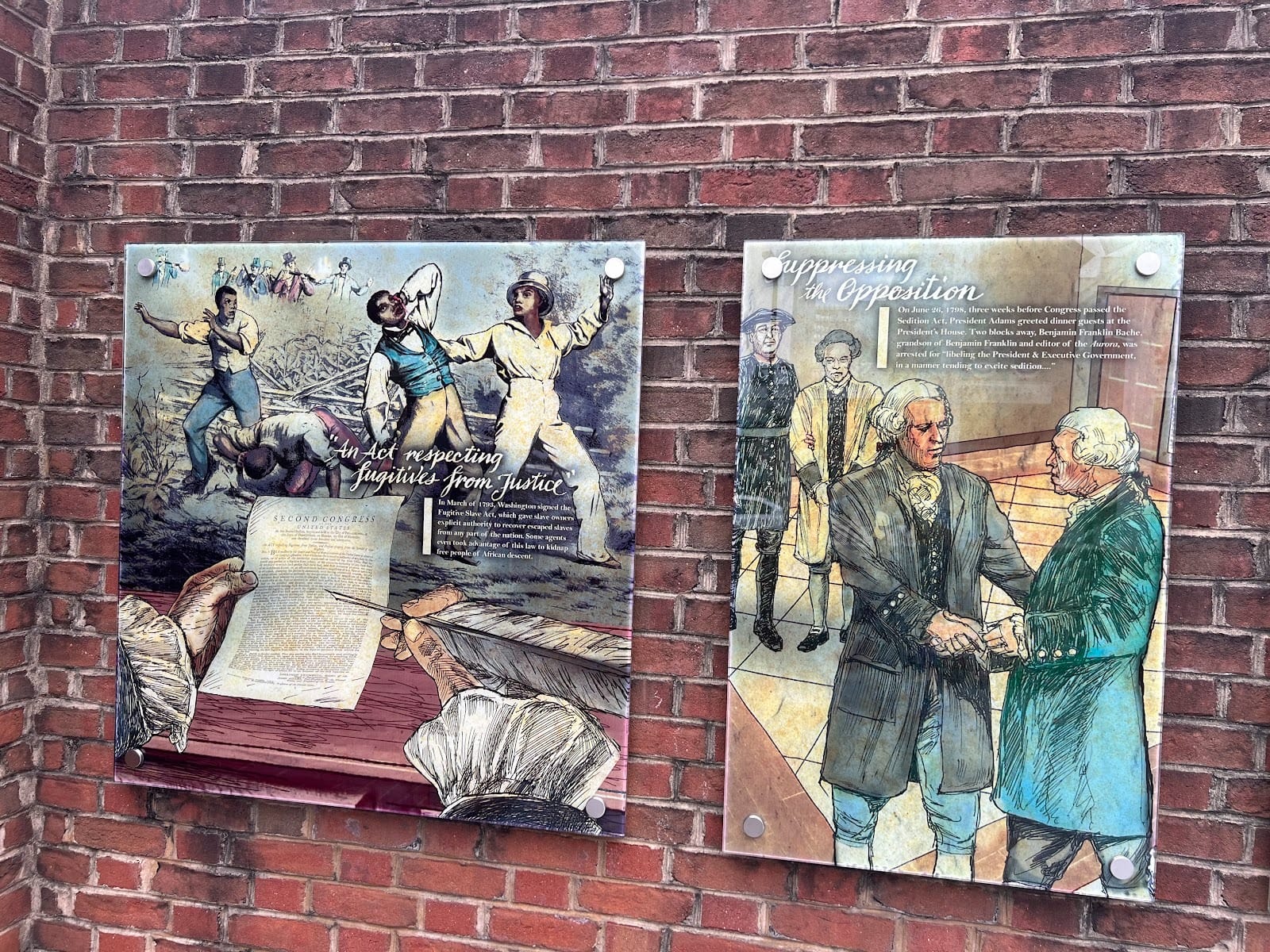
In obedience to Trump’s March 2025 executive order banning all uncomfortable history (“divisive” is his administration’s term) from federal property, the site’s panels and placards were ripped from the walls and the video presentations turned off without so much as notice to the city, let alone consultation.
According to agreements of cooperation from 2006, all changes are to be collaborative between the city and NPS. The city argues that the agreement of collaboration is still in force. The NPS argues that the agreement to cooperate ended in 2010 once the project was completed.
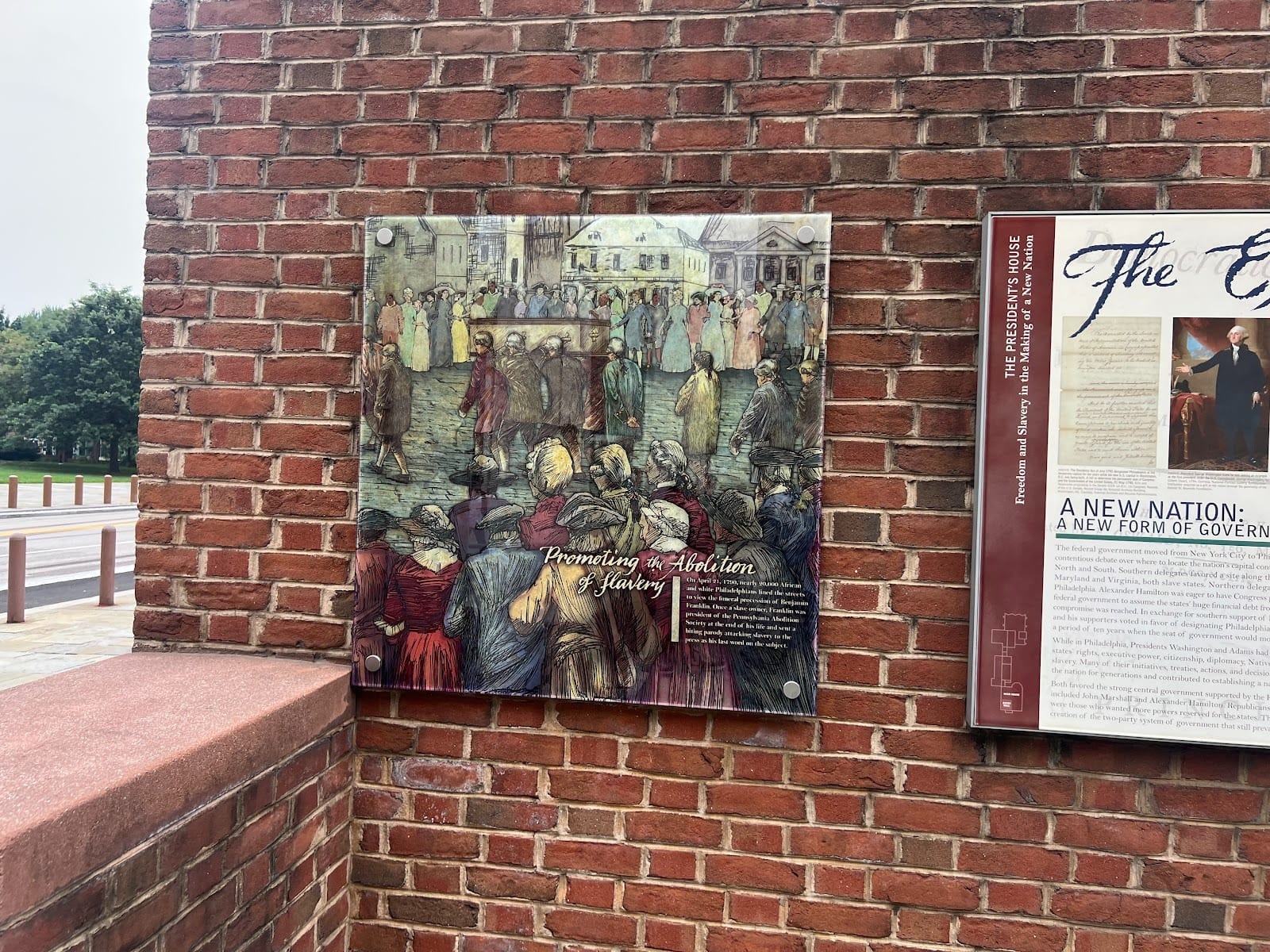
Despite Philadelphia’s millions of dollars in investment, the Fed’s lawyers argue, the city has no say and the NPS can do whatever they want whenever they want to. This includes destroying the product of decades of work.
Philadelphia city solicitor Renee Garcia argued passionately that collaboration was a key part of the agreement and that requirements of collaboration survive the expiration of other portions of the agreement upon the exhibit’s completion. Garcia honed in on the real subject at hand: truth-telling regarding the nation’s history. She concluded her opening argument: “The site holds the history and stories of all Americans. That story is just as much Ona Judge’s as yours or mine.”
The mmm hmmms in the room sounded like the affirmations after a pastor’s resonant turn of phrase in a Black church.
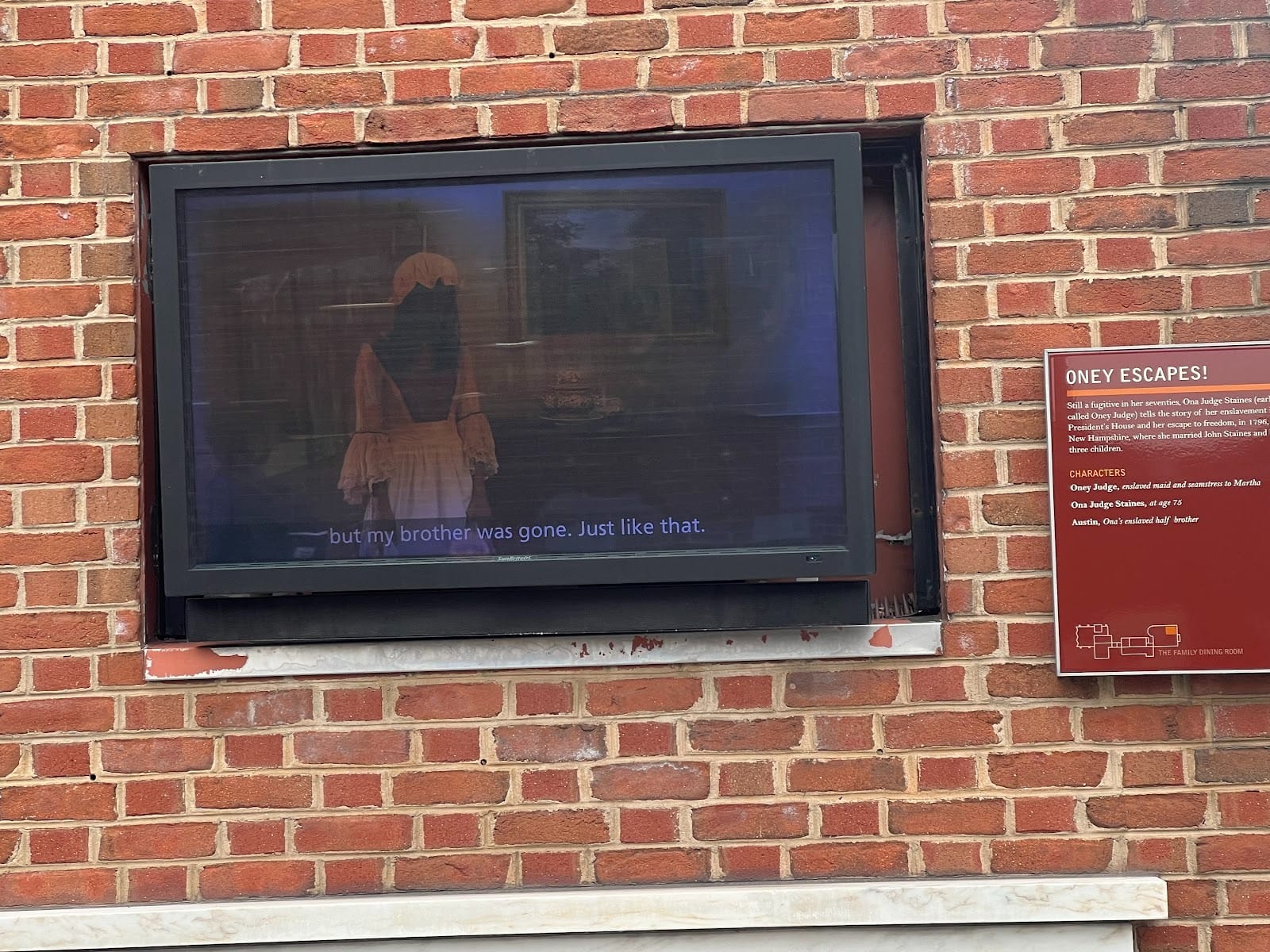
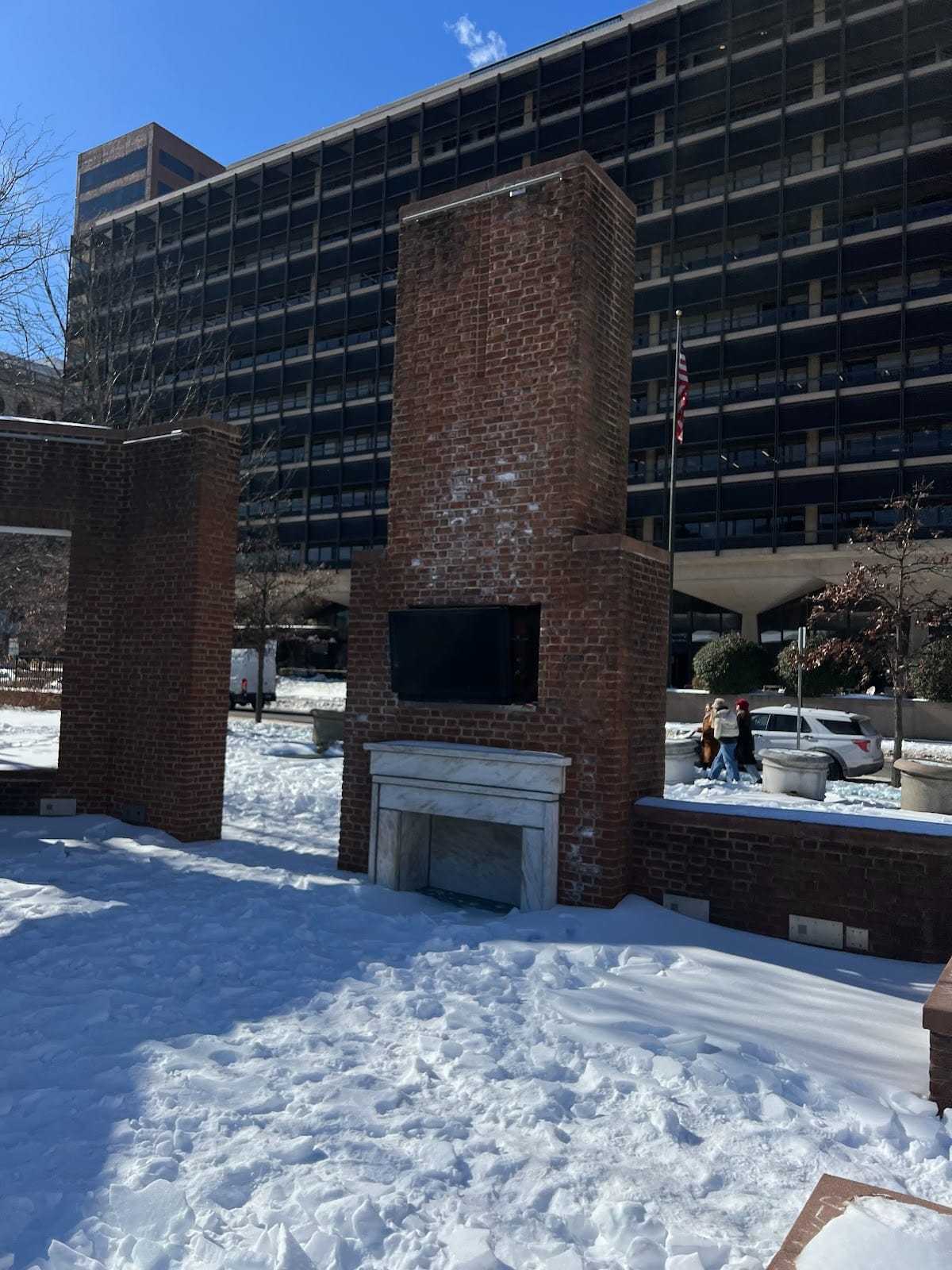
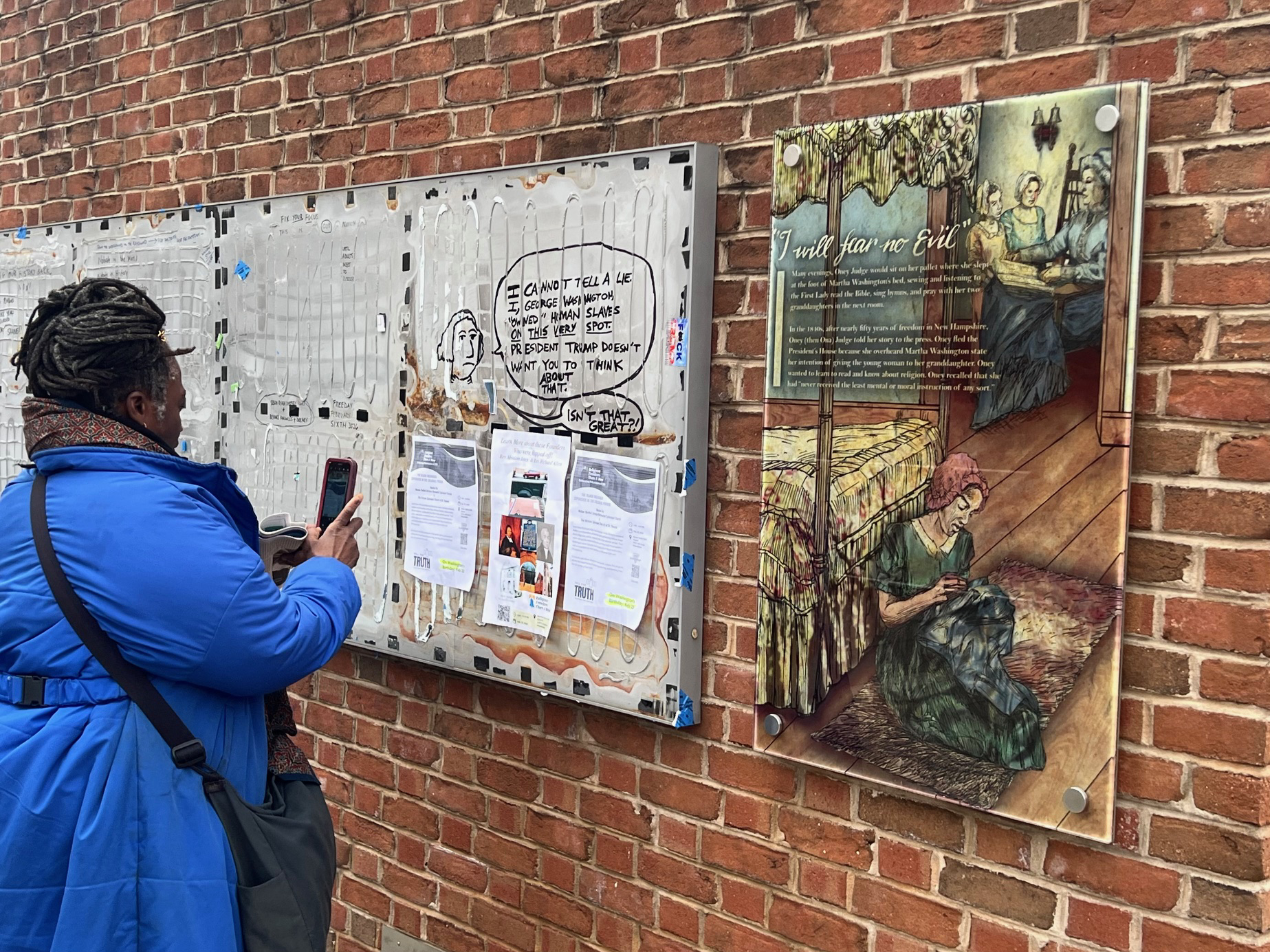
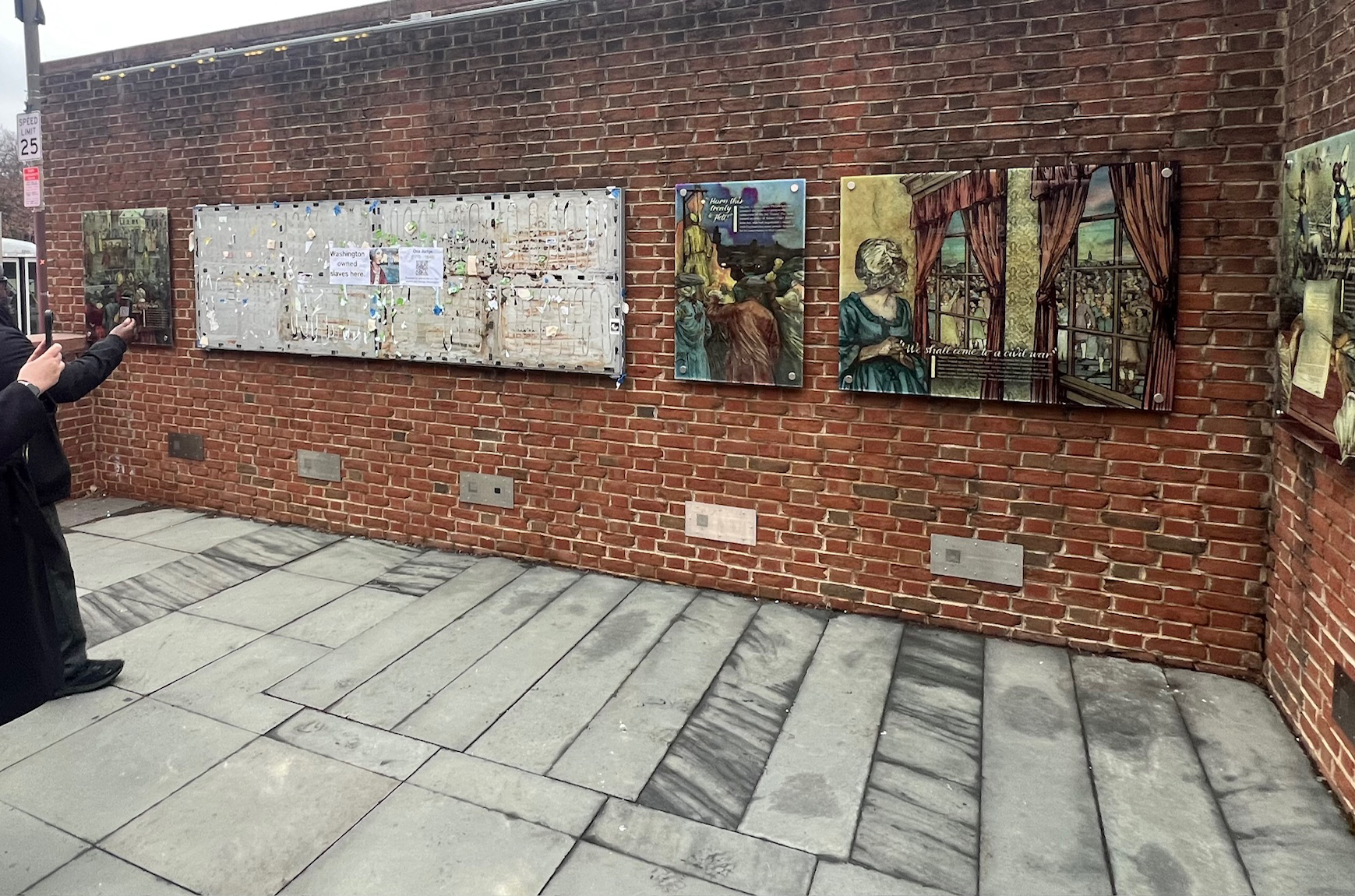
Those affirmations, like those of many a Black American congregation through the centuries, registered profound knowing. Some two weeks later, on February 16, 2026, Judge Rufe issued her ruling. The city’s suit has merit, and the judge issued an injunction requiring the National Park Service to restore the exhibit. A mere three days after that, on the 19th, workers dug the panels out from storage and returned them to their rightful places. At least most of them.
After the workers left, the Avenging the Ancestors Coalition played joyful jazz and invited speakers onto a makeshift stage. Interested folks roamed through the site, happily taking photos of the restored panels. I ran into a friend I hadn’t seen in a while and we took pictures together. Though the sky was winter-gray and there was a wet chill in the air, we had a jubilee. Yet, marks remain of the battle—Judge Rufe’s ruling calls it a “dispute.”
As of February 19th, not all the panels were yet restored. Some may be damaged.
We partied, even while the empty spots reminded us that History lives. Because it lives, it will speak its injuries. Sometimes it speaks most loudly with silence.
Public Humanities and a Global Antiquity
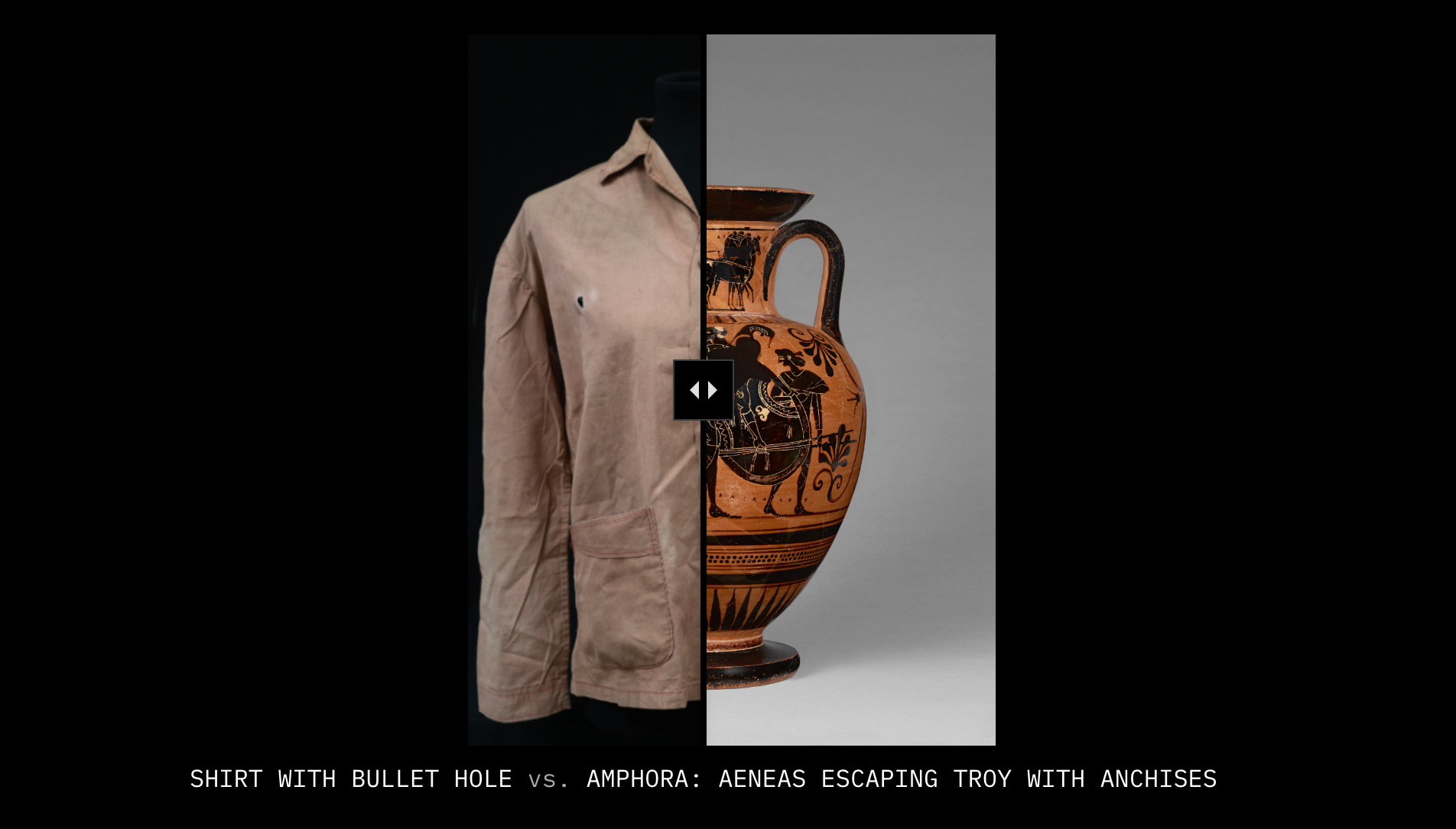
The Refugee Material Culture Initiative (RMCI) "is a community-engaged, digital humanities project with the aims of 1. digitally preserving art and artifacts made/used by refugees, 2. creating a free and accessible database of the digital outputs, and 3. generating educational resources on refugee histories." UCLA Professor Kelly Nguyen, with support from the the Cotsen Institute of Archaeology and the UCLA Library, partnered with the Vietnamese Heritage Museum in order to underscore the material culture surrounding refugees.
In open access news, classicist and noted gladiator sweat stan Maxwell Teitel Paule has a new, open access Latin textbook, Heroines of Greek and Roman Myth: An Intermediate Latin Reader (Open Book Publishers, 2026). If you like this intermediate reader but want to pair it with something for younger kids, I'd also suggest picking up Yung In Chae's Goddess Power: A Kids' Book of Greek and Roman Mythology: 10 Empowering Tales of Legendary Women.
This volume offers students a fresh approach to reading Latin through the lens of women’s stories in classical myth. Too often, the myths encountered in Latin classrooms center on men, while women are pushed to the margins or depicted primarily as victims of violence. This reader deliberately shifts focus, presenting narratives of nine heroines without requiring students to navigate accounts of sexual assault—an important consideration when the challenge of mastering Latin syntax is already demanding.
In addition to these books on women and myth, ancient historian Cristina Rosillo López has a new popular book, Romanas. Voces rescatadas, which tells Roman history through the eyes of ancient women from enslaved persons to empresses.
![Maxwell Teitel Paule, Heroines of Greek and Roman Myth: An Intermediate Latin Reader (Open Book Publishers, 2026) [Open Access].](https://pasts-imperfect.ghost.io/content/images/2026/01/image-16.png)
The new special issue of the Bulletin of the Institute of Classical Studies (BICS) is focused on "Numidia and Rome." It has quite a few contributions that are open access. All of the articles are worth reading and, as editors Thomas Biggs and Mathilde Cazeaux note, "the largest grouping of articles in the special issue engages the reception of ancient Numidia, or at least some receptions of certain Roman imaginary Numidias. Through these articles, the special issue unpacks cases in which the classical past informs practices of imperialism and colonialism in North Africa, showing how the ancient world can be retooled as a lens for contemporary acts of violence and oppression." Sometimes the past can help us see the present more clearly.
In archaeology happenings, Arkeonews notes that archaeologists have begun to challenge the white archetype of the American cowboy by uncovering "forgotten Chinese cowboys in Eastern Oregon, revealing how Chinese immigrants shaped ranching, buckaroo culture, and the American West." One in four American cowboys were also Black. In Oaxaca last week, news came that Mexico’s National Institute of Anthropology and History (INAH) discovered a 1,400-year-old Zapotec tomb. And Alexandria on the Tigris, Alexander the Great's "forgotten metropolis," is now being unearthed in modern-day Iraq.
Let's check in on some PI friends. Over in AJR, classicist Del A. Maticic has a great essay on "A Snow Day in the Life of a Classicist Turned High School English Teacher," and then Lindsey Mazurek is on Ancient Office Hours with Lexie Henning. We'd also like to say congrats to Candida Moss for winning the Richards Award for Public Scholarship from the SBL and Rachel Schine for winning the Monica H. Green Prize for Distinguished Medieval Research. κῦδος to all!
At the Constantinus Africanus blog, Monica H. Green has a post on "Science and Migration" in Honor of World Leprosy Day 2026.
In this past year, one of the youngest fields of science, paleogenomics, pushed back the history of leprosy in the “new” worlds of the Americas by at least 10,000 years. As specialists in leprosy around the world will admit, social stigma creates barriers to open discussion and humane treatment. Although leprosy has long carried that burden, recognizing it as a global disease gives us a new way to think beyond stigma and focus instead on shared histories.
The essay is also dedicated to the memory of Francis Lanneau Newton, (28 February 1928 – 14 February 2025), amicus optimus Constantini Africani.
We should also note that Alfredo Calahorra Bartolomé's new Cambridge Elements book on Constantinople's The Great Palace, is free to read until February 12! And if you want to follow up on Inger N.I. Kuin's piece on Diogenes the Cynic in our previous issue, have a listen to her discussion on Philosophy Talk. And don't miss the teaser on the Cynic lifestyle of Anarcho-Punk band Crass.
Yes, people, we are finally in Olympics season! If you are indeed an Olympics purist, you will know that ancient Greek participants called for and honored a no-war policy for the duration of the games. We still do this today, with limited effect—but Kirsty Coventry, the first woman to lead the International Olympic Committee, has hope.
"Even in these dark times of division, it is possible to celebrate our shared humanity and inspire hope for a better future."
Over at Lit Hub, Sophie Pinkham explores the myths and realities of the ancient taiga in her new book The Oak and the Larch: A Forest History of Russia and Its Empires. Siberian forests may seem like the middle of nowhere, but people throughout the ages built fortifications and homes along river basins, traded furs across continents, and inspired their own mythologies.

It is ridiculous to argue over Lupita Nyong'o reportedly playing Helen in Nolan's forthcoming interpretation of the Odyssey this summer. Helen was born from an egg, y'all. An egg. You and I both know that this debate isn't really about maintaining "historical veracity." Myth is meant to be flexible, universal, and adapted. Whether it is Achilles in Troy: Fall of a City (2018), the Muses of Hercules (1997), or the work of artists like Harmonia Rosales: the goal of Greek mythology is to illustrate the struggles of all humanity.
Calliope (Lillias White), Clio (Vanéese Y. Thomas), Thalia (Roz Ryan), Terpsichore (LaChanze), Melpomene (Cheryl Freeman) are the Muses of Hercules (1997).
New Ancient World Journals by @yaleclassicslib.bsky.social
American Journal of Philology Vol. 146, No. 4 (2025) #openaccess NB Joel P. Christensen "State of Play:
Computing Homer from Wissenschaft to AI"
Ancient Narrative Vol. 20 (2024) #openaccess
Annual of the British School at Athens Vol. 120 (2025)
Archéologie et histoire ancienne Vol. 12 (2025) #openaccess
Bulletin of the Institute of Classical Studies Vol. 68, No. 2 (2025) Numidia and Rome
The Classical Quarterly Vol. 75, No. 1 (2025)
Erga-Logoi Vol. 13, No. 2 (2025) #openaccess
Frontières Vol. 11 (2025) #openaccess Les frontières du sacré
Hermes Vol. 153, No. 4 (2025)
Historia Vol. 75, No. 1 (2026)
Ibadan Journal of the Classics and Multidisciplinary Studies Vol. 36 No. 1 (2024) #openaccess Nigeria and the Classics
Mare Nostrum Vol. 13 no. 1 (2022) #openaccess
Mouseion Vol. 21, No. 1 (2024) Breaking New Ground with Comics and the Ancient Mediterranean World
Syllogos - Herodotus Journal Vol. 4 (2025) #openaccess NB Doris Post Essay Prize: Nazım Can Serbest "Reproduction, Expansionism and the Nature–God Tension in Herodotus"
Vita Latina No. 206 (2026) #openaccess
Ancient Philosophy Vol. 46, No. 1 (2026) NB Luc Brisson & Salomon Ofman "On an Unnoticed Geometrical Paradox in Timaeus’ Cosmology"
Comparative Philosophy Vol. 17, No. 1 (2026) #openaccess
Études platonicienne Vol. 20 (2025) #openaccess L'Empeiria chez Platon
Journal of Ancient Philosophy Vol. 19 No. 2 (2025) #openaccess
Medicina nei Secoli Vol. 37 No. 3 (2025) #openaccess
Dead Sea Discoveries Vol. 33, No. 1 (2026) Intersectional Investigations into the Complexity of Social Life in Early Judaism
Journal for the Study of Judaism Vol. 57, No. 1 (2026)
Armeniaca Fasc. 4 (2025) #openaccess
Hieroglyphs Vol. 3 (2025) #openaccess
Indo-Iranian Journal Vol. 69, No. 1 (2026)
Journal of Ancient Near Eastern Religions Vol. 25, No. 2 (2025)
Journal of the Canadian Society for Coptic Studies Vol. 15 (2023) NB Jennifer Cromwell "Re)constructing Coptic Lives in Late Antiquity"
Journal for Semitics Vol. 34, No. 1-2 (2025)
Le Muséon Vol. 138, Nos. 3-4 (2025)
Zeitschrift für altorientalische und biblische Rechtsgeschichte Vol. 31 (2025)
Archiv für Epigraphik Vol. 5, No. 2 (2025) #openaccess Vulpes annosa non capitur.
Festschrift für Rüdiger Fuchs zum 70. Geburtstag
Bulletin du centre d’études médiévales d’Auxerre Vol. 29, No. 2 (2026) #openacces
Dumbarton Oaks Papers Vol. 79 (2025) #openaccess NB Lucas McMahon, “Signaling Empire between the Abbasid-Byzantine Frontier and Constantinople: Investigations on the Ninth-Century Long-Distance Optical Telegraph"
Humanistica Lovaniensia Vol. 74 (2025) #openaccess
European Journal of Archaeology Vol. 29, No. 1 (2026)
Journal of Social Archaeology Vol. 26, No. 1 (2026)
Journal of the Warburg and Courtauld Institutes Vol. 88 (2025)
Workshops, Lectures, and Exhibitions
At the Brooklyn Museum, the exhibition “Unrolling Eternity: The Brooklyn Books of the Dead” started last Saturday. “After a three-year restoration project, the exceptionally rare, 21-foot-long manuscript will be presented." And this Saturday (February 7) at 5pm CST, Foy Scalf, Director of the ISAC Data Research Center and Research Archives Library, will present the ARCE- ISAC Joint Lecture "A Festival to Re-Member: Celebrating the Mysteries of Osiris in Ancient Egypt" at the Institute for the Study of Ancient Cultures in Chicago and online.
On February 11, 2026 at 7:00 pm, The Cleveland Archaeological Society of the AIA welcomes Emily Van Alst to discuss "Embodied Stone: Indigenous Knowledge, Gender, and the Archaeology of Rock Art." You can register for the zoom version here or head over to the Cleveland Museum of Art.
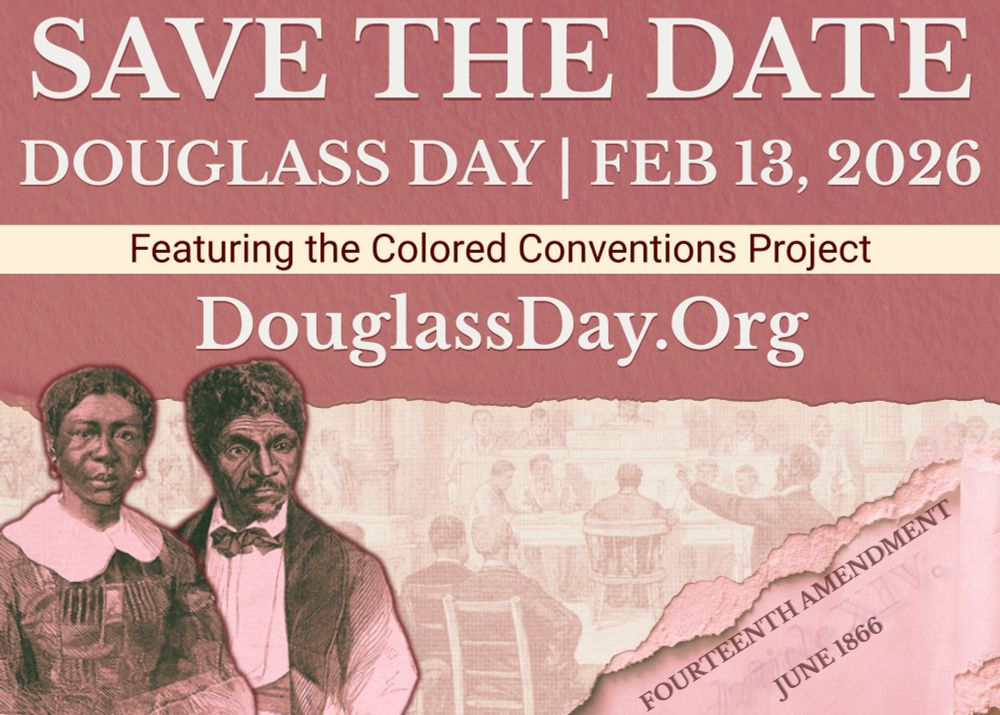
On February 13, 2026, classrooms and history lovers across the country will be participating in Douglass Day—a document transciption-a-thon to celebrate Black History Month on Frederick Douglass' birthday (what an Aquarian!). Big thanks to the Colored Conventions Project (CCP) for running this every year. Register here.
On Tuesday, February 17th, at 5:30pm EST the Center for the Study of World Religions at Harvard will host "Porphyry of Tyre on Theology and Theurgy: Oracular Voices and Luminous Intellect" online and in person, marking the publication of Fabien's Muller's edition and translation of the fragments of "Porphyry's Letter to Anebo" and "Philosophy from Oracles" in CSWR's new series Texts and Translations of Transcendence and Transformation (4T), published by Harvard University Press.
Over at the British School in Rome, the fourth lecture in a series of five regarding Material Environments will be hosted jointly by the American Academy in Rome and the British School at Rome. On Wednesday, February 25, 2026 at 6:00 PM (12:00 pm ET), Sabine Huebner will speak on "Resilient Landscapes: Climate, Economy, and Human Adaptation in the Roman Sabina." Register for zoom attendance here.